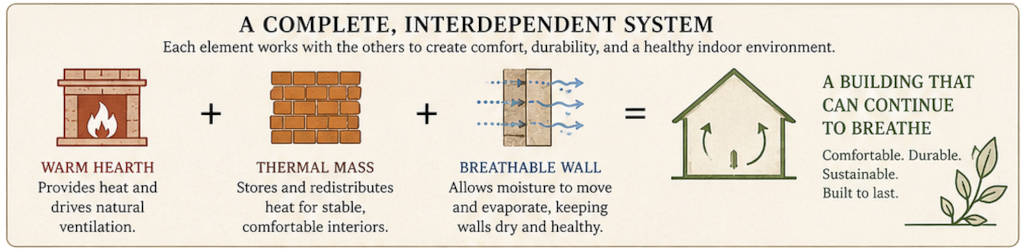
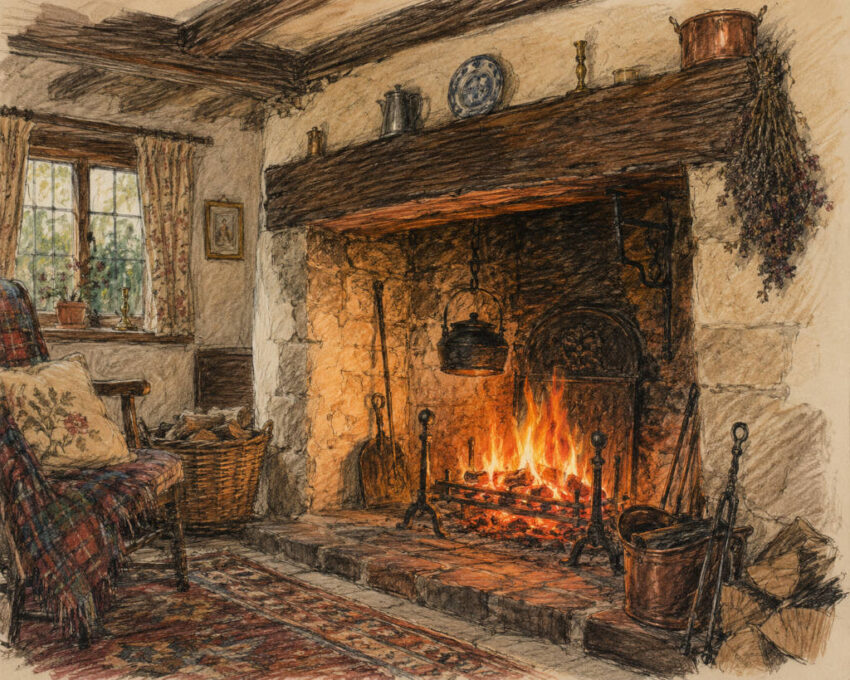
Period surviving properties are traditionally constructed from locally quarried stone, lime mortar, lime plaster, with thick solid masonry walls and a large open hearth serving the principal living area.
An open fire with adequate ventilation creates a natural draw of air. The resulting movement of air and heat interacts with the masonry around the fireplace:
1. Cold air is drawn into the room
As heated air from the fire rises through the chimney, cooler replacement air is naturally drawn to the hearth through the building’s natural ventilation paths (this allowance for ventilation and airflow is why traditional properties can be considered draughty).
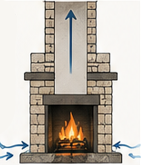
2. The fire warms the masonry
The masonry surrounding the hearth absorbs heat from the fire. Masonry walls are traditionally built as thick natural stone to give a high thermal mass (which allows heat to be stored).
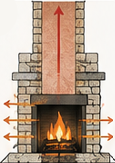
3. Heat moves through the wall
Heat gradually transfers through all of the walls within the space. This helps to moderate the temperature of the walls and creates conditions in which moisture can later evaporate.
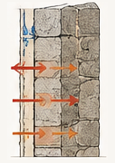
4. Moisture can migrate and evaporate
Moisture transmission is a key characteristic of traditional materials: Stone, lime mortar and lime plaster contain interconnected pores. The pores can absorb moisture, redistribute and release moisture through evaporation, allowing the wall to naturally dry when the external environment permits.
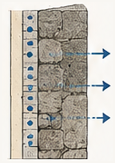
5. Stored heat gradually releases
The high thermal mass allowed the masonry to store heat, it also allows a gradual release of heat rather than immediately losing it. This is a traditional, efficient way to keep a property warm and dry.
Summary
Traditional materials can absorb and release moisture gradually. By contrast, inappropriate impermeable repairs can trap moisture within the wall, potentially accelerating decay, mould and fungus. Heritage Property Repairs therefore treat an external wall as an active part of a traditional building rather than a simple barrier.
A traditional building works as a system. The hearth, chimney, solid masonry, lime mortar, plaster and ventilation are interconnected. Changing one element – for example, replacing permeable lime mortar with dense cement – can disrupt the moisture and thermal behaviour of the whole system.